How Is Art During the the Crusedes Fought for the Muslems and Christians for What
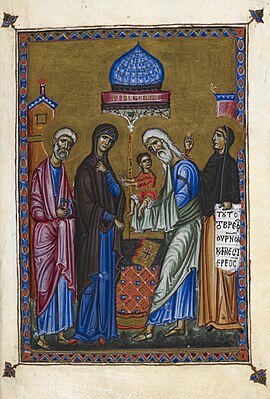

Crusader art or the art of the Crusades, meaning primarily the art produced in Middle Eastern areas under Crusader control, spanned ii creative periods in Europe, the Romanesque and the Gothic, just in the Crusader kingdoms of the Levant the Gothic style barely appeared. The military crusaders themselves were more often than not interested in artistic and development matters, or sophisticated in their taste, and much of their fine art was destroyed in the loss of their kingdoms so that only a few pieces survive today. Probably their most notable and influential creative accomplishment was the Crusader castles, many of which achieve a stark, massive beauty. They adult the Byzantine methods of urban center-fortification for stand-alone castles far larger than whatsoever constructed earlier, either locally or in Europe.
The crusaders encountered a long and rich creative tradition in the lands they conquered at the terminate of the 11th century and the first of the 12th. Byzantine and Islamic art (that of both the Arabs and the Turks) were the dominant styles in the Crusader states, although at that place were also the styles of the indigenous Syrians and Armenians. These ethnic styles were incorporated into styles brought by the crusaders from Europe, which were themselves highly varied, stemming from France, Italia, Germany, England, and elsewhere. On the whole the Eastern Christian styles were more significant influences than Islamic fine art; the artists working in the Crusader lands are causeless to have had the same variety of backgrounds. Many art historians try to guess the backgrounds, in terms of ethnicity, place of birth and preparation, of the artists involved with item works, an effort treated with caution by Kurt Weitzmann, Doula Mouriki, and Jaroslav Folda, author of the most recent detailed survey.[1]
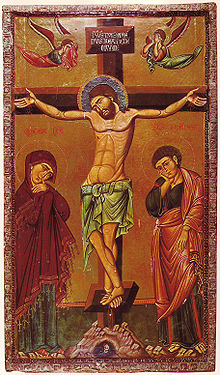
Crusader fine art in the Levant, like the history of the Crusader kingdoms in general, falls clearly into ii, or three, periods. The first begins with the Outset Cause which culminated in 1099 with the bloody taking of Jerusalem and the institution of the Kingdom of Jerusalem and other states to the due north. The following decades were turbulent merely artistically productive, until the catastrophe of 1187 saw the Crusader defeat at the Battle of Hattin and the fall of Jerusalem to Saladin. In the second period the Kingdom of Jerusalem was now hugely reduced in size to command only a few littoral towns and the areas effectually them, which were gradually whittled away by the Muslims until the final Siege of Acre (1291) concluded Crusader presence in the Levant. Notwithstanding the kingdom nevertheless controlled Republic of cyprus, taken from the Byzantine Empire, and the House of Lusignan continued to dominion there, and later the Armenian Kingdom of Cilicia, until respectively 1489 and the late 14th century, representing the third flow of Crusader art, not counted as such by all sources; in Cyprus the Gothic style is often found.[2]
There is a farther sense of "Crusader art" to cover the art produced in the Latin Empire that usurped much of the Byzantine Empire, ruled by the Crusaders betwixt the Sack of Constantinople in 1204 past the Fourth Crusade and 1261. Saint Catherine'southward Monastery in Sinai was also a centre during this time, and perhaps later. This art had a larger affect in Europe, to which many artists probably returned after the collapse of the regime, influencing Italo-Byzantine painting there. The crusades were also important as a subject in Western art, mainly in illuminated luxury versions of the many histories that were popular reading with Western elites.
Illuminated Manuscripts [edit]
An example of the mixture of different styles is the Melisende Psalter, an illuminated manuscript produced in the mid-12th century, maybe for Queen Melisende of Jerusalem. Information technology reflects her European and Armenian heritage, and is too influenced by Byzantine and Islamic techniques. The Saint Catherine'south Monastery in Egypt was an important centre where a school of manuscript and icon painting that blended European and local influences emerged. Fortunately it has besides been a very secure habitation for its collection of icons (only non manuscripts in Latin, all of which were subsequently destroyed, patently under Russian influence), and then a expert number have survived at that place. Artists who can exist identified on stylistic grounds as originating in France and Italia (Venice and Apulia) worked at that place, producing work mixing Byzantine and Western conventions, but usually with lettering in Greek. This was possible because by a quirk of Orthodox history the church there was in communion with both the Cosmic and the other Orthodox churches, so the normal sectarian divides that separated the crusaders from fifty-fifty the local Christians did not operate.
There was also a scriptorium in Acre which produced many well known manuscripts such every bit missals and the Arsenal Bible,[3] peculiarly noted for commissions by Rex Louis IX of French republic.[4] The frontispiece to Proverbs 1 in the Arsenal Bible shows Solomon wearing the traditional insignia and vesture of a Byzantine emperor, in a mixture of the Gothic and Franco-Byzantine Crusader styles, and also shows French architecture.[4] Well-nigh of the pregnant surviving illuminated manuscripts were produced in the 13th century, nearly one-half in the last twoscore years of the Latin kingdom; to what extent this is an accident of survival is unclear.[iv]
Mosaics, Frescoes and Panel Paintings [edit]
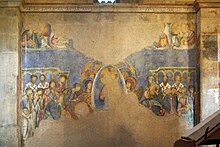
An example of the mixture of styles is the Church building of the Holy Sepulchre in Jerusalem, the renovation and rebuilding of which was completed in 1149; however only fragments of the large programme of mosaics now survive. This was until the loss of Jerusalem in 1187 the establishment with the principal Crusader scriptorium, from which six manuscripts survive, made in a mixture of royal and church building commissions.[v] About of the significant surviving illuminated manuscripts were produced in the 13th century, virtually half in the last twoscore years of the Latin kingdom; to what extent this is an blow of survival is unclear.[6] Some icons in wall painting and mosaic survive from the Church of the Nascency in Bethlehem.[5] The Hospitaller church at Abu Ghosh, apparently and so regarded as the biblical Emmaus, was abased in 1187 merely has good remains of frescos. Some wall paintings and mosaic sections survive from the Church of the Nativity in Bethlehem,[v] and there are frescoes at Lagoudhera on Republic of cyprus.[three]
Sculpture [edit]

Figurative awe-inspiring sculpture in relief was, some before Armenian work apart, not part of local Christian traditions, so the Romanesque sculpture of Europe, especially France, was much the largest influence. Discussion of the varied styles by art historians typically involves just various areas in Europe, mostly in France. Many elements were re-used in later buildings, and have now re-appeared, often desperately damaged. Original work has survived at the Church building of the Holy Sepulchre, whose carved lintels are now in the Rockefeller Museum in the city, and was removed from the destroyed Church of Santa Maria Latina nearby.
Another major pilgrimage basilica, the Church building of the Annunciation in Nazareth, was but nearing the completion of a major rebuilding in 1187. Saladin in fact left the Christians in place and does non seem to have damaged the building. Still the church was seriously damaged in the next major upheaval in the area, the invasion in 1267 past the Mamluk ruler Baybars, and the sculptures remaining from the church all suffered. In 1908 v actress capitals were excavated, having, information technology is presumed, been buried in 1187 soon after they were made but before they were put in place, when news of Saladin'southward arroyo reached the town. These are in excellent status, and some of the nigh famous sculptures of the Crusader flow.[vii]
The situation is rather different with decorative sculpture, where local influence is much stronger. The beautifully carved and complex ornament on the arches and cornices over the doors into the Church of the Holy Sepulchre is dissimilar anything in French republic from this period and reflects local evolution of Syrian late Roman styles; some parts are probably re-used Roman fabric. The neighbouring capitals, "based on Justinianic models, are probably the work of local Christian sculptors working for the Latins".[8]
The end [edit]
After the rapid collapse of the Kingdom of Jerusalem in 1187, which must accept destroyed a great part of the artwork the crusaders produced,[9] they were mostly confined to a few cities on the Mediterranean coast until Acre was conquered in 1291. Their artistic output did not cease during the 13th century, and shows further influences from the art of the Mamluks and Mongols.
In Cyprus, the Lusignan kingdom continued to produce piece of work, including the Gothic cathedrals of Famagusta (Lala Mustafa Pasha Mosque) and Nicosia (Haydarpasha Mosque/Saint Catherine and Selimiye Mosque/Saint Sophia Cathedral), all subsequently used equally mosques and relatively well-preserved (minus their figurative sculpture).
Gallery [edit]
-
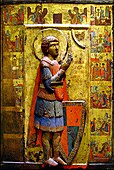
Latin Empire damaged icon, from a Greek church. The cardinal figure of St George is in painted relief, and conspicuously Latin in manner and clothing
-
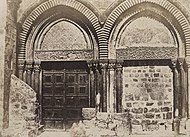
The Holy Sepulchre lintels, withal in identify in 1856.
-
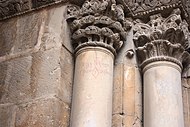
Holy Sepulchre entrance capitals
Influences on Europe [edit]
There was also cause-related art produced back in Europe, from the many illuminated crusade chronicles such as the Quondam French translation of William of Tyre, to architecture such as the round churches built by the Knights Templar in the way of the Holy Sepulchre, and the Sainte-Chapelle in Paris built to adjust relics brought back from the East. Luxurious printed textiles began to exist produced in Europe at around the terminate of the Crusades, and may well have been some other influence. In general, it is frequently not possible to say with certainty whether influences or new types of objects arriving in Europe at this period did then via Islamic Espana, the Byzantine earth, or the Crusader states. Historians tend to disbelieve the importance of the Crusader States in this regard, despite the very well developed Italian trading networks at that place. European castle-edifice was certainly decisively influenced by the crusaders.
See also [edit]
- Repoblación art and architecture
Notes [edit]
- ^ Folda, I, thirteen, quoting Weitzmann; I, 17–18, quoting Mouriki; Chase, Lucy-Anne (1991). "Art and Colonialism: The Mosaics of the Church of the Nascency in Bethlehem (1169) and the Problem of "Crusader" Art". Dumbarton Oaks Papers. 45: 69–85. doi:10.2307/1291693. JSTOR 1291693.
- ^ Folda restricts himself to the art of the "Holy Land" or "Syria-Palestine", Folda, I, 19-20
- ^ a b Weitzmann, Kurt (1966). "Icon Painting in the Crusader Kingdom". Dumbarton Oaks Papers. twenty: 49–83. doi:10.2307/1291242. JSTOR 1291242.
- ^ a b c Jaroslav., Folda (2008). Crusader art : the fine art of the Crusaders in the Holy State, 1099-1291. Aldershot: Lund Humphries. ISBN9780853319955. OCLC 229033386.
- ^ a b c Folda, I, 28
- ^ Folda, I, 13
- ^ Folda, I, 27-28
- ^ Setton and Hazard, 270
- ^ discussed in detail at Folda, I, 23-28
References [edit]
- Folda, Jaroslav. Crusader Art in the Holy Country: From the Tertiary Crusade to the Autumn of Acre, 1187–1291, Cambridge Academy Press, 2005. (ISBN 9780521835831)
Farther reading [edit]
- Evans, Helen C. & Wixom, William D., The celebrity of Byzantium: art and culture of the Middle Byzantine era, A.D. 843-1261, pp. 389, 1997, The Metropolitan Museum of Art, New York, ISBN 9780810965072; full text available online from The Metropolitan Museum of Art Libraries
- Folda, Jaroslav. Crusader Art in the Twelfth Century, B.A.R., 1982.
- Folda, Jaroslav. Crusader Art: The Art of the Crusaders in the Holy Country, 1099–1291. Aldershot: Lund Humphries, 2008. (ISBN 9780853319955)
- Kühnel, Bianca. Crusader Art of the 12th Century: A Geographical, an Historical, or an Art Historical Notion?, Berlin: Gebr. Mann, 1994.
- Weiss, Daniel H. Art and Crusade in the Historic period of Saint Louis, Cambridge Academy Press, 1998. (ISBN 9780521621304)
External links [edit]
- University of Michigan commodity
Source: https://en.wikipedia.org/wiki/Art_of_the_Crusades
0 Response to "How Is Art During the the Crusedes Fought for the Muslems and Christians for What"
Post a Comment